|
CATEGORIES
|
|
| HEALTH | |
| PRESCRIPTIONS | |
| GENERAL MEDICINE | |
| PERSONAL CARE | |
| MEDICAL AIDS | |
| ANIMAL HEALTH | |
 |
 |
||||||||||||||
|
||||||||||||||
|
||||||||||||||
|
Policies
|
||||||||||||||
|
||||||||||||||
|
Pharmacist
available for contact
|
||||||||||||||
|
||||||||||||||
 |
||||||||||||||
 |
 |
|
|||||||||||||||||||||||||||
| Suncare Part 2 | |||||||||||||||||||||||||||||
SunburnWhen
you get sunburn, your skin is actually damaged at the cellular level
by UV radiation, your body then responds to the damage. The body
responds to the damage by increasing blood flow to the capillary
bed of the dermis in order to bring in cells to repair the damage.
The redness that occurs is due to the increase in blood flow to
the area. If you press on sunburned skin it will turn white and
then return too red as the capillaries again refill. Allergic Rhinitis need not necessarily be seasonal and can occur throughout the year. When symptoms are perennial (all year round) the likely allergens are from the immediate environment and allergen challenges are continuous. With perennial Hayfever symptoms, environmental control measures can be most useful in reducing the severity and frequency of the allergy. Seasonal allergy sufferers are more likely to obtain benefit from drug therapy as allergens causing their symptoms tend to be out of their immediate control. How Sunscreens Work Sunlight
arrives on earth in three forms: infrared (heat), visible light
and ultraviolet. Ultraviolet light is classified into three categories:
Many
brands of sunscreens are available, containing an array of ingredients.
The active ingredients work by absorbing, reflecting, or scattering
some or all of the sun's rays. Sunscreens carry a sun protection
factor (SPF) rating on their labels. The higher the number, the
longer a person can stay in the sun without burning. The SPF acts
like a multiplying factor. If you would normally be OK in the sun
for 10 minutes then you will be protected in the sun for 150 minutes
if you were to apply sunscreen with an SPF of 15 1.
organic chemical compounds that absorb ultraviolet light
Other Products Recent research also shows that antioxidant supplementation may protect our skin. Supplementation with carotenoids (25 mg/day) and vitamin E (500 IU/day) may be useful for diminishing sensitivity to ultraviolet light. Children in the Sun
Medication UseAnyone who is using a prescription or non-prescription (over-the-counter) drug that is applied to the skin should check with a doctor before using a sunscreen. Medications commonly taken to fight acne may increase the risk of sunburn. People taking medications such as antibiotics (including tetracyclines, sulfa, and quinolones) or retinoids should take extra sun safety precautions. Other medications include diuretics, antifungals and nonsteroidal anti-inflammatories. The same applies to bergamot, an ingredient in some fragrances, as well as mangoes, celery, fennel, figs, parsnip, and lime rinds. Care in the Sun Sunscreens
are integral to a person's total sun protection strategy, however
sunscreen use alone will not prevent all of the possible harmful
effects due to sun exposure. Apply sunscreen before you go outside.
This ensures that hard to reach areas wont be neglected, and to
be protected from the incidental sun exposure on your way to your
destination.
2. Use a lip balm containing sunscreen to protect the lips. 3. Any clothing that is thin enough to see through will let the sun through too. When possible, wear a hat, long pants, a long-sleeved shirt. Wet clothing is an even less effective sun barrier. 4. The sun is strongest between 10 a.m. and 3 p.m. 5. The sun can damage the skin even on cloudy days, so itÕs important to use a sunscreen every day. Be especially careful at high elevations or in areas with surfaces that reflect the sun's rays, such as sand, water, concrete, or snow. People
with fair skin, light coloured hair and eyes are at greatest risk
for developing skin cancer. So are people with many large skin moles.
These people should avoid exposure to the sun as much as possible.
However, even darker skinned people may suffer skin damage from
the sun and should be careful about the sun.
|
|||||||||||||||||||||||||||||
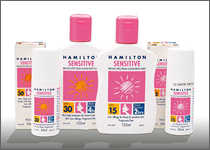 Some
products provide broad spectrum protection against UVA and UVB rays
while others only protect against UVB. The SPF rating applies only
to UVB radiation. Products are available in water-resistant and
waterproof formulas. Other differences in sunscreen formulations
include their feel on the skin, fragrance, ease of application and
the ability to not stain. Skin type is important when choosing a
formula. Those who are acne-prone should avoid oil-based products
and tend toward lighter, alcohol-based gels. Those with dry skin
should seek creamier formulations. Those who have sensitive and
allergy prone skin should use hypoallergenic formulas free of PABA,
fragrances, and benzophenone.
Some
products provide broad spectrum protection against UVA and UVB rays
while others only protect against UVB. The SPF rating applies only
to UVB radiation. Products are available in water-resistant and
waterproof formulas. Other differences in sunscreen formulations
include their feel on the skin, fragrance, ease of application and
the ability to not stain. Skin type is important when choosing a
formula. Those who are acne-prone should avoid oil-based products
and tend toward lighter, alcohol-based gels. Those with dry skin
should seek creamier formulations. Those who have sensitive and
allergy prone skin should use hypoallergenic formulas free of PABA,
fragrances, and benzophenone. 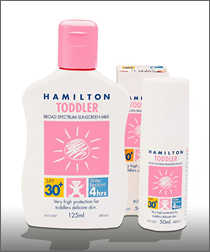 Studies
reveal that a history of sunburns during the first ten to twenty
years of life doubles the risk of skin cancer in later years. Sunscreen
may be applied to children as young as six months old, unless your
doctor indicates otherwise. Infants should be kept out of direct
sunlight. Infants under 6 months of age should be kept away from
any amount of UV exposure, as their skin is thinner and not capable
of producing sufficient melanin to adequately protect it. A baby's
skin is also less efficient at cooling itself. 80 percent of lifelong
sun damage occurs before the age of 18. So, kids need to be reminded
to use sunscreen and wear a hat and sunglasses.
Studies
reveal that a history of sunburns during the first ten to twenty
years of life doubles the risk of skin cancer in later years. Sunscreen
may be applied to children as young as six months old, unless your
doctor indicates otherwise. Infants should be kept out of direct
sunlight. Infants under 6 months of age should be kept away from
any amount of UV exposure, as their skin is thinner and not capable
of producing sufficient melanin to adequately protect it. A baby's
skin is also less efficient at cooling itself. 80 percent of lifelong
sun damage occurs before the age of 18. So, kids need to be reminded
to use sunscreen and wear a hat and sunglasses. 